
You haven’t picked up a tennis racket in years. Maybe ever. Yet lifting a coffee mug, turning a doorknob, or shaking hands sends a sharp ache into the outside of your elbow.
That is very often tennis elbow, and despite the name, most people who get it don’t play tennis.
Here is the short answer. Tennis elbow is irritation of the tendon that anchors your forearm muscles to the outside of your elbow. It usually develops when gripping and wrist work ask more of that tendon than it is ready to handle. Most cases improve with time and the right kind of exercise. But recovery speed varies a lot, and one reason is where along the muscle and tendon the problem sits.
What is tennis elbow?
Feel the bony bump on the outside of your elbow. That is the lateral epicondyle. Several forearm muscles that lift your wrist and fingers attach there through a shared tendon. The one most often involved is called the extensor carpi radialis brevis, or ECRB.
Every time you grip something, these muscles switch on to hold your wrist steady. Pick up a full suitcase and you can feel them tighten just below the elbow.
The medical names are lateral elbow tendinopathy or lateral epicondylalgia. You may also hear “lateral epicondylitis,” but the “-itis” (inflammation) is misleading. When researchers sampled the tendon in people with long-standing tennis elbow, they found no signs of typical inflammation. The tendon tissue is better described as overloaded and disorganized than inflamed. That matters, because it explains why rest and anti-inflammatory treatment alone often don’t solve it.
How do you get tennis elbow if you don’t play tennis?
Tennis elbow affects roughly 1 to 3% of adults, most often between ages 45 and 54. A large population study from Finland found that physical workload, smoking, and obesity were all linked to it. Tennis players get it too, but they are a small share of the total.
The common thread is unaccustomed gripping. Your tendon adapts to the loads you give it regularly. Problems tend to start when the load jumps faster than the tendon can keep up. Common examples include:
- A weekend of painting, drilling, or using a screwdriver
- Pruning, raking, or pulling weeds after a long winter
- Carrying heavy grocery bags, a toddler, or a laptop bag on one arm
- Trades and manual work involving tools and repeated gripping
- A new gym program with lots of rows, deadlifts, or pull-ups
- Picking up pickleball, golf, or tennis later in life
Typical symptoms include pain on the outside of the elbow that may spread into the forearm, pain with gripping or lifting with your palm facing down, a weaker grip, and tenderness when you press on the bump.
Other problems can feel similar. Irritation of a nerve near the elbow, the elbow joint itself, or pain referred from the neck can all show up in the same area. This is one reason an evaluation is worthwhile when symptoms don’t settle.
Why don’t all tennis elbow cases recover the same way?
The encouraging news first: most people get better. In a well-known JAMA trial of 165 people with tennis elbow, 96% of those who received a placebo injection reported complete recovery or much improvement at one year.
But “most people within a year” can still mean months of frustration, and some cases linger. A population study from the Mayo Clinic area suggested that people whose symptoms hadn’t resolved by about six months may be in for a longer course.
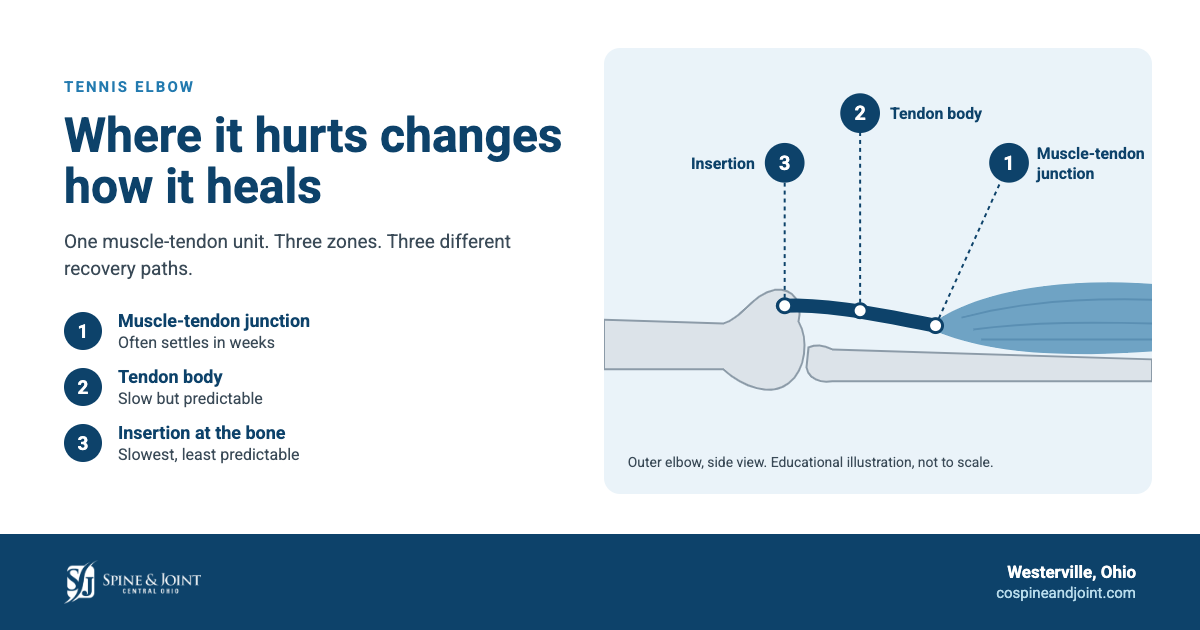
One reason for these differences is location. Think of the muscle and tendon as one continuous unit with three distinct zones, each with its own biology.
| Zone | Where it is | Typical behavior |
|---|---|---|
| Muscle-tendon junction | A few centimeters down the forearm, where muscle turns into tendon | Good blood supply. Tends to heal like a muscle strain, often over weeks. The main risk is returning to heavy use too quickly. |
| Tendon body | The cord-like middle of the tendon | Limited blood supply. Slow, but usually predictable. Often responds well to progressive strengthening over several months. |
| Insertion (enthesis) | Where the tendon anchors into the bone; the most common site for tennis elbow | Specialized tissue that handles both pulling and squeezing forces. Tends to be the slowest and least predictable to recover. |
What does the research say?
The clearest comparison between these zones comes from the Achilles tendon at the heel, which has been studied far more than the elbow. In one study of eccentric (lowering) calf exercises, 89% of people with pain in the middle of the tendon returned to their previous activity after 12 weeks. Only 32% of people with pain at the insertion did.
When researchers changed the exercise so it no longer squeezed the insertion against the bone, 67% of insertional patients were satisfied and back to activity at follow-up. The tendon hadn’t changed. The approach had.
To be clear, those numbers describe heel tendons, not elbows. Researchers have not measured success rates by zone for tennis elbow in the same way. What carries over is the principle: insertional tendon problems often behave differently from mid-tendon problems, and the rehabilitation plan may need to be adjusted for them.
The research also offers a caution about cortisone shots. In the same JAMA trial, people who received a corticosteroid injection had worse one-year results than the placebo group (83% vs. 96% improved) and a much higher recurrence rate (54% vs. 12%). Injections can provide short-term relief, so this is a conversation worth having with your physician rather than a hard rule.
Finding where the problem really is: shockwave mapping
If location affects recovery, the next question is obvious: where is your problem?
A thorough exam starts the answer. That includes your history, pressing on specific spots, testing your wrist and finger strength against resistance, measuring grip, and checking your neck, nerves, and elbow joint. Diagnostic ultrasound can show the tendon’s structure, though tendon changes don’t always match symptoms.
As part of a focused shockwave consultation, our clinicians may add one more step: a low-energy shockwave mapping pass. Focused shockwave concentrates its energy at a set depth, unlike radial shockwave, which spreads out from the skin’s surface. That precision lets the clinician move slowly across the attachment, the tendon body, and the muscle-tendon junction.
Sensitive tissue often responds with a familiar, recognizable ache. When you say “that’s my pain,” it helps confirm which zone is most involved. That guides where treatment is aimed and what timeline is realistic to expect.
It is important to be clear about what mapping is not. It isn’t a standalone diagnostic test, and how you respond to it does not predict your recovery on its own. It is one piece of information interpreted alongside the rest of your exam.
Shockwave as a treatment has mixed but encouraging evidence for tennis elbow. A 2020 review of randomized trials found better pain and grip strength with shockwave than with comparison treatments, while noting that study quality was limited. Shockwave isn’t appropriate for everyone, and it works best as part of a plan that includes strengthening.
The COSJ approach: Repair, Retrain, Reinforce
Because the three zones behave differently, we don’t use one plan for every elbow.
Repair focuses on calming things down. That may mean adjusting how you grip and lift, gentle isometric exercises, manual therapy, and focused shockwave when it fits your presentation.
Retrain builds the tendon’s capacity with progressive strengthening of the wrist, fingers, and grip. For insertional cases, we often adjust positions and progressions to limit compression at the bone, the same lesson the Achilles research taught.
Reinforce is about returning to your work, hobbies, and training with strength to spare, so the next big weekend project doesn’t start the cycle again.
Practical takeaways
- Don’t stop using your arm completely. Complete rest tends to weaken the tendon you are trying to protect.
- Reduce the specific tasks that flare it, and lift with your palm facing up when you can.
- A useful rule of thumb: mild discomfort during activity is usually acceptable if it settles by the next morning.
- Think carefully about repeated cortisone injections, and discuss the trade-offs with your physician.
- Get evaluated if symptoms haven’t improved after about six weeks, or if you notice numbness, tingling, or weakness in your hand.
Seek prompt medical care if elbow pain follows a fall or injury with swelling or deformity, if you cannot bend or straighten your elbow, or if the area becomes hot, red, and swollen with a fever.
The bottom line
Tennis elbow is common, usually comes from everyday gripping rather than tennis, and most people recover. How quickly depends partly on where the tendon is irritated, and that is something a careful evaluation can help clarify.
If elbow pain is getting in the way of your work, workouts, or weekends, our team at Central Ohio Spine and Joint in Westerville can evaluate where your symptoms are coming from and discuss whether focused shockwave therapy and a progressive strengthening plan make sense for you. [COSJ Consultation Booking Link — Confirm Before Publishing]
Frequently asked questions
How long does tennis elbow last? Many cases improve within a few months, and most people are much better within a year. Symptoms lasting beyond six months may need a more structured plan.
Should I wear a brace? A forearm strap may ease pain during certain tasks for some people. It can support activity, but it does not replace strengthening.
Is shockwave therapy painful? Treatment is often uncomfortable, and the intensity is adjusted to your tolerance. Your clinician will explain what to expect before starting.
This article is intended for educational purposes and does not replace an individualized medical evaluation.
Recent Comments