
You get adjusted, stand up, and turn your head. It moves farther than it did ten minutes ago. Your back feels looser when you bend to tie your shoes.
That change is real, and research helps explain it. Spinal manipulation can briefly change how your nervous system processes pain and movement. But feeling better after an adjustment is not the same as being able to handle the demands of your day, your workouts, or your sport.
At Central Ohio Spine and Joint (COSJ) in Westerville, that distinction shapes how we practice. We use spinal manipulation as one tool. What happens after the adjustment, especially exercise, is often what turns short-term relief into lasting function.
What an Adjustment Actually Does
The familiar “pop” is not what helps. It is gas releasing within the joint, and studies have not linked the sound to better results.
A spinal manipulation applies a quick, controlled force to a joint. That force stimulates sensory receptors in the surrounding muscles, joints, and connective tissue. Those receptors constantly report to your spinal cord and brain about position, movement, and load. Changing that input can temporarily change how your nervous system responds.
Researchers have studied three main effects.
1. Changes in pain processing
Pain is not a simple signal from damaged tissue to the brain. It is shaped by your nervous system, past experiences, expectations, and how threatening a situation seems.
Studies show manipulation can briefly reduce pain sensitivity and change reflex activity around the spine. Laboratory and animal research suggests the body’s own pain-control pathways may be involved. This helps explain why some people feel immediate relief.
What it does not mean is that an injury has healed, or that the demands contributing to your symptoms have been addressed. Relief can be a useful first step. It is rarely the last one.
2. Changes in muscle activity
Some studies have measured short-term changes in spinal reflexes and in how excitable the muscles around the spine are after manipulation. Results vary between studies.
This matters for one reason: changing how a muscle is switched on for a few minutes is different from making it stronger. Strength and endurance come from exercise and progressive loading, not from any hands-on treatment.
3. Changes in proprioception
Proprioception is your body’s sense of where it is in space. It is why you can touch your nose with your eyes closed, and it helps coordinate bending, lifting, and balance.
A randomized trial published in Scientific Reports in November 2025 tested this directly. Researchers studied 142 adults, 90 without back pain and 52 with chronic low back pain. Each person received a lumbar manipulation, a gentler lumbar mobilization, or no treatment.
After manipulation, participants’ balance relied more on sensory input from the low back muscles. That shift was larger than after mobilization or no treatment, and it appeared in people with and without back pain. Among the 52 people with back pain, those who already relied more on low back input before treatment tended to report more pain relief.
The limits matter. These effects were measured immediately after a single session. We do not know how long they last or whether they improve movement or function over time. Other trials have found that one manipulation session reduced local pain sensitivity but did not improve balance.
Does Manipulation Improve Mobility?
Often, yes, at least in the short term, and the evidence is clearest for the neck.
A 2025 meta-analysis of acute neck pain pooled three trials with 271 people. Groups that received spinal manipulation gained roughly 7 to 11 degrees more neck motion than comparison groups, depending on direction. However, the researchers rated the certainty of that evidence as very low. The trials were small, follow-up was short, and manipulation was often combined with other treatments.
Evidence for improved motion in the low back is less convincing. And in either region, we do not know how long gains in motion last.
That is why we do not describe adjustments as permanently realigning the spine. We see manipulation as a way to make movement more comfortable, so patients can take part more fully in rehabilitation.
The Therapeutic Window: Using Relief to Introduce Movement
If an adjustment makes bending less uncomfortable for a while, why not use that time well?
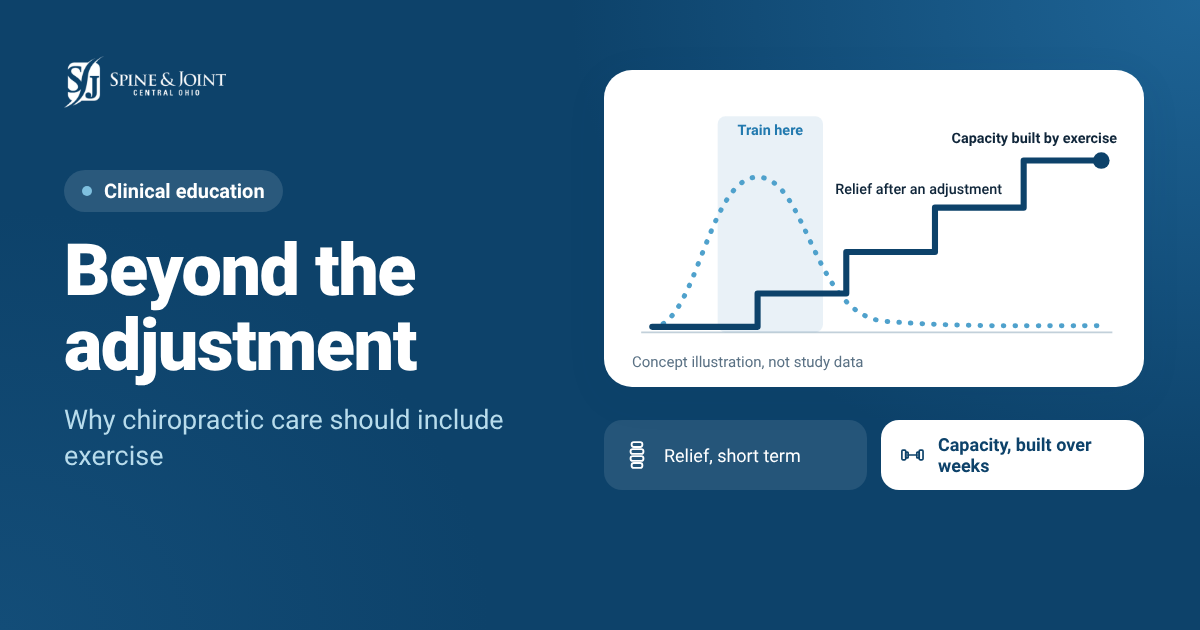
Consider a hypothetical example. A patient with low back pain is hesitant to bend forward. After manipulation, bending feels easier. Rather than ending the visit there, we may introduce controlled spinal movement, hip mobility work, or trunk strengthening while movement feels more manageable. The adjustment may create the opportunity. The exercise starts building capacity.
We want to be clear: this “therapeutic window” is a clinical idea, not an established finding. Research has not defined how long such a window lasts. Nor has it shown that exercising right after manipulation beats exercising at another time. Similar short-term effects can also follow mobilization, other hands-on care, and patient expectations.
The broader principle is well supported, though. When movement becomes more tolerable, that is a good time to help someone become more active.
Why an Adjustment Alone May Not Be Enough
Large reviews and clinical guidelines support spinal manipulation as a reasonable option for low back pain. The American College of Physicians lists it among first-line, non-drug treatments. But a 2019 BMJ review of 47 trials found that, for chronic low back pain, manipulation produced effects similar to other recommended treatments such as exercise. It is a valid choice, not a superior one.
Now picture someone whose back pain flares when lifting. An adjustment may ease their symptoms, and they may leave feeling much better. But if they have not built enough strength, endurance, and confidence for lifting, the same task can bring the same problem back.
That does not mean the adjustment failed. It means reducing symptoms and building capacity are two different goals. Manipulation can help with the first. Progressive exercise is central to the second.
How We Use Manipulation at COSJ: Repair → Retrain → Reinforce
Our care is organized in three overlapping phases. Manipulation has a different job in each.
Repair. Early on, the goal is to calm irritable symptoms and restore comfortable movement. Depending on your exam, that may include manipulation or mobilization, soft-tissue work, dry needling, focused shockwave therapy, education, and early exercise. Exercise does not wait until you are pain-free. It starts at a level you can tolerate.
Retrain. As symptoms settle, the focus shifts to what your exam showed you need, such as trunk endurance, hip strength, or confidence lifting heavier loads. Manipulation may still help if stiffness is limiting progress. But strength comes from consistent, well-dosed exercise.
Reinforce. Feeling better is a milestone, not the finish line. Without continued training, strength gains fade. Some patients continue on their own. Others transition to The Training Room, our coached strength training facility, to keep building capacity long term. Either way, the goal is independence: managing your physical health through exercise rather than depending on treatment.
Does Everyone Need an Adjustment?
No. Some patients do very well with exercise alone. Others benefit more from mobilization, soft-tissue treatment, or a combination. Manipulation is also not appropriate for everyone, including people with certain medical conditions or risk factors. We weigh your history, exam findings, preferences, goals, and response to care.
How We Measure Progress
Pain matters, but it is not the only measure. We also ask whether you can do more. Can you sit through a workday? Lift your kids without hesitation? Get back to golf, running, or lifting? Tolerate more activity than when you started?
Those answers tell us whether care is working.
The Bottom Line
Spinal manipulation can produce real, short-term changes in pain, movement, and how your nervous system processes sensory information. Guidelines support it as one reasonable option for back pain. But an adjustment does not build strength, endurance, or tolerance for daily demands. Exercise does.
Our goal is not to become very good at adjusting your spine. It is to help you become very good at using your body.
Schedule a Consultation in Westerville
If you are dealing with recurring back pain, neck stiffness, or a sports injury that keeps limiting what you do, our team at Central Ohio Spine and Joint can evaluate your symptoms and discuss whether manipulation, exercise, or a combination makes sense for you.
Frequently Asked Questions
Does the popping sound mean the adjustment worked? No. The sound comes from gas releasing within the joint. Research has not linked it to better outcomes.
How long do the effects of an adjustment last? Research has mostly measured effects immediately after treatment or over short follow-up periods. How long they last varies between people and is not well established.
Should I exercise after a chiropractic adjustment? For many people, yes, within their tolerance and as part of a plan built from their exam. Your clinician can help you decide what is appropriate.
When should I see a medical provider instead? Seek prompt medical care for back pain with new bowel or bladder changes, numbness in the groin or inner thighs, progressive leg weakness, fever, or pain after significant trauma.
This article is intended for educational purposes and does not replace an individualized medical evaluation.
References:
- Nyirö L, et al. The impact of spinal manipulation on lumbar proprioception and its link to pain relief: a randomized controlled trial. Sci Rep. 2025 Nov 26;15:42136. doi:10.1038/s41598-025-25985-3. Supports the proprioception section. Correction: the draft omitted the mobilization arm and the 90/52 split; manipulation outperformed both mobilization and no treatment, and the pain-relief link applied to the 52 patients with chronic low back pain.
- Diao Y, et al. Efficacy and safety of spinal manipulative therapy in the management of acute neck pain: a systematic review and meta-analysis. Syst Rev. 2025;14:97. Source of the 7–11 degree figure. Correction: that range comes from only 3 trials (271 people), rated very low certainty, with manipulation often combined with other care. The article now says so.
- Rubinstein SM, et al. Benefits and harms of spinal manipulative therapy for the treatment of chronic low back pain. BMJ. 2019;364:l689. 47 trials; manipulation produced effects similar to other recommended therapies. Added to support “a valid choice, not a superior one.”
- One spinal manipulation session reduces local pain sensitivity but does not affect postural stability in individuals with chronic low back pain (randomised, placebo-controlled; 80 participants). Supports “other trials found no balance improvement.” Confirm author list and journal from the PMC page before citing by name.
- Qaseem A, et al. Noninvasive treatments for acute, subacute, and chronic low back pain: a clinical practice guideline from the American College of Physicians. Ann Intern Med. 2017;166(7):514–530. doi:10.7326/M16-2367. Supports the guideline statement.
- Bialosky JE, et al. The mechanisms of manual therapy in the treatment of musculoskeletal pain: a comprehensive model. Man Ther. 2009;14(5):531–538. Supports the pain-processing mechanisms section.
Recent Comments